
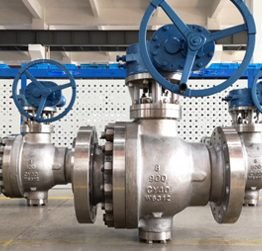
Industrial Ball Valve Selection for Reliable Service
Technical guide reviewed: October 2026

The short answer
Choose a floating ball valve for many small-bore, moderate-pressure isolation duties. Consider a trunnion-mounted design when size, pressure or operating torque becomes high. Use soft seats when tight shutoff and compatible temperature conditions are the priority; consider metal seats for abrasive media, frequent cycling or elevated temperature. Final selection must follow the approved piping specification and the valve manufacturer’s pressure-temperature rating.
How should industrial ball valve selection begin?
Industrial ball valve selection begins with a complete process datasheet. The manufacturer needs the normal and maximum pressure, normal and design temperature, fluid name, fluid state, concentration, solids content, flow direction and required leakage performance. This information determines whether the proposed body, trim and seat materials can remain safe and functional throughout the operating range.
Specify the real operating case rather than only the line class. A valve installed in a Class 300 line may experience rapid decompression, high differential pressure, low-temperature start-up or abrasive particles. Each condition can change the seat design, stem sealing, cavity relief arrangement and actuator torque.
- Fluid name, composition and concentration
- Design pressure and maximum differential pressure
- Minimum, normal and design temperature
- Required size, bore and end connection
- Operating frequency and expected cycle rate
- Shutoff direction and leakage requirement
- Manual, pneumatic, electric or hydraulic operation
- Applicable valve, testing and project standards
Which construction supports reliable industrial ball valve selection?
A floating ball valve uses the pressure of the medium to move the ball toward the downstream seat. The construction is compact and is widely used for small and medium sizes. The required operating torque and seat load rise as size and pressure increase, so a floating design should not be selected from nominal size alone.
A trunnion-mounted ball valve supports the ball with fixed upper and lower bearings. The seats move toward the ball, which helps control torque in larger sizes and higher-pressure pipeline service. Trunnion-mounted valves can also be configured with double block and bleed, cavity pressure relief and emergency sealant injection when required by the project specification.
Top-entry construction allows access to internal parts from above and may suit locations where removing the valve from the pipeline is difficult. Side-entry construction is common in pipeline service and can be supplied in two-piece or three-piece body arrangements. The preferred design depends on maintenance access, end connection, bore, pressure class and site procedures.
Industrial ball valve selection by service condition
This industrial ball valve selection table is a starting point for engineering review. It does not replace the project datasheet or a material compatibility assessment.
On a phone, swipe left or right inside the table to view all columns.
How does the process medium affect industrial ball valve selection?
Industrial ball valve selection requires materials that resist both general corrosion and local damage at seats, stem areas, body cavities and flange crevices. Carbon steel is commonly specified for compatible oil, gas and utility service. Austenitic stainless steels may suit many water and chemical duties, but material grade alone does not confirm compatibility.
Duplex and super duplex stainless steels are often considered for chloride-bearing water, seawater and offshore service because their strength and resistance to chloride-induced attack can exceed conventional austenitic grades under suitable conditions. For an application example, see the WDL Duplex Ball Valve. Nickel alloys, Monel, titanium and nickel-aluminum bronze may be selected for specific corrosive media after reviewing concentration, temperature, aeration and fluid velocity.
Industrial ball valve selection must cover every wetted component, not only the body. The ball, stem, seat supports, springs, seals and bolting may experience different corrosion or galling risks. Ask the supplier to state the material of each pressure-containing and wetted part in the datasheet.
How should industrial ball valve selection compare soft and metal seats?
During industrial ball valve selection, soft seats are normally preferred when very tight shutoff, moderate temperature and clean compatible media are required. PTFE, reinforced PTFE, PEEK and other engineered polymers have different limits for temperature, pressure, chemical resistance and deformation. The seat designation must therefore be checked against the complete operating envelope.
Metal seats are considered for abrasive particles, high temperature, rapid pressure changes, severe erosion or frequent cycling. A metal-seated ball valve may use hardened or coated sealing surfaces, but the required leakage class must be agreed before manufacture. “Metal seated” does not automatically mean zero leakage under every condition.
For decompression service, the seat and seal system may also need resistance to rapid gas decompression. For fire-risk duties, specify the required fire-safe design and test standard. These requirements should appear on the purchase specification rather than being assumed from the product name.
Does bore size matter in industrial ball valve selection?
Industrial ball valve selection must compare bore geometry. Full-bore ball valves provide an internal passage close to the connected pipe bore. They are often specified where pressure loss must be low, cleaning pigs must pass or solids could collect at a restriction. Reduced-bore valves can lower weight and cost where the calculated pressure drop and flow velocity remain acceptable.
The word “full bore” should be supported by an agreed minimum bore dimension. This is especially important for piggable pipelines and large valves. Confirm the bore, face-to-face dimension and end preparation on the approved drawing before production.
How does industrial ball valve selection affect actuator sizing?
Industrial ball valve selection also includes actuator sizing. An actuator must be sized from the valve’s maximum required operating torque, not from nominal pipe size. The calculation should consider maximum differential pressure, seat friction, service factor, supply pressure, operating time and the required fail position. Dry gas, long idle periods, low temperature and deposits can increase the torque needed in service.
Pneumatic actuators suit fast, repeatable operation where compressed air is available. Electric actuators are useful where electrical control and slower travel are acceptable. Hydraulic actuators can provide high torque for pipeline and emergency shutdown applications. Limit switches, solenoid valves, positioners and manual overrides must match the control philosophy and hazardous-area classification.
Which standards and tests should be confirmed?
Industrial ball valve selection must identify the applicable standard, which depends on the industry and valve duty. ASME B16.34 covers pressure-temperature ratings and other requirements for many flanged, threaded and welding-end valves. API Specification 6D applies to valves used in pipeline and piping systems within its stated scope. The purchase order should identify the required edition and any project-specific additions.
Testing may include shell pressure, high-pressure closure, low-pressure gas closure, antistatic continuity, fire-safe qualification, fugitive-emission testing, cryogenic testing and nondestructive examination. Not every test is required for every valve. Industrial ball valve selection is more reliable when the inspection and documentation scope is agreed before the order is placed.
What selection mistakes cause early valve problems?
A common industrial ball valve selection mistake is choosing the valve from pressure class and body material while leaving the seat and seals unspecified. Another is using maximum pressure and maximum temperature as separate values without checking whether they can occur at the same time. The complete pressure-temperature curve must be reviewed.
Oversized actuators can damage stems or seats, while undersized actuators may stall under maximum differential pressure. Incorrect flow direction can prevent a single-piston-effect seat from relieving cavity pressure as intended. A valve installed for throttling may also suffer seat and ball erosion if the design was intended only for open-or-closed isolation.
What should be included in an industrial ball valve selection RFQ?
A complete RFQ improves industrial ball valve selection because it allows the manufacturer to review the application instead of making assumptions. Send the following information with the inquiry:
- Valve quantity, nominal size and pressure class
- Process medium, concentration and solids content
- Design pressure, differential pressure and temperature range
- Body, ball, stem, seat and seal material requirements
- Full bore or reduced bore and required minimum bore
- Flanged, butt-weld, socket-weld or threaded ends
- Floating or trunnion design and required seat action
- Manual operator or actuator control details
- Design, testing, fire-safe and emission standards
- Inspection documents, certificates and third-party witness points
Ball valve engineering support from WDL Valve
WDL Valve supports industrial ball valve selection and supplies floating, trunnion-mounted, top-entry, side-entry, cryogenic and special-alloy ball valves for industrial projects. Review our industrial ball valve manufacturer capabilities. Available materials include carbon steel, stainless steel, duplex and super duplex stainless steel, titanium, nickel alloys, Monel and nickel-aluminum bronze, subject to the approved project specification.
Send the medium, size, pressure, temperature, material and operating requirements to discuss your ball valve application with WDL Valve.
Frequently asked questions about industrial ball valve selection
Can a ball valve be used for flow control?
A standard ball valve is mainly an isolation valve. Limited throttling may be possible with an engineered control-ball design, characterized trim and correctly sized actuator. Holding a general-service ball valve partly open can damage the seat and ball through high velocity or cavitation.
When does industrial ball valve selection favor a trunnion-mounted design?
A trunnion-mounted ball valve is often preferred for large size, high pressure or high differential pressure because the supported ball helps control operating torque. The final choice depends on valve size, pressure class, seat design and pipeline requirements.
How should industrial ball valve selection address seawater materials?
Duplex stainless steel, super duplex stainless steel, titanium, Monel and nickel-aluminum bronze may be considered for seawater, depending on temperature, velocity, oxygen content, chlorination and galvanic conditions. A seawater material assessment should cover all wetted components.
Does industrial ball valve selection guarantee zero leakage with metal seats?
No. Metal-seated ball valves are commonly used for high temperature, abrasive media and frequent cycling, but acceptable leakage depends on the specified test standard and leakage class. State the required acceptance criterion in the RFQ.
What is the most important information for industrial ball valve selection?
The most important information is the process medium, design pressure, full temperature range, maximum differential pressure, shutoff requirement and operating frequency. These values guide the selection of the body design, material, seat and actuator.
2 Comments